

1. The 2025 Price Shift: AI Efficiency vs. Integration Complexity
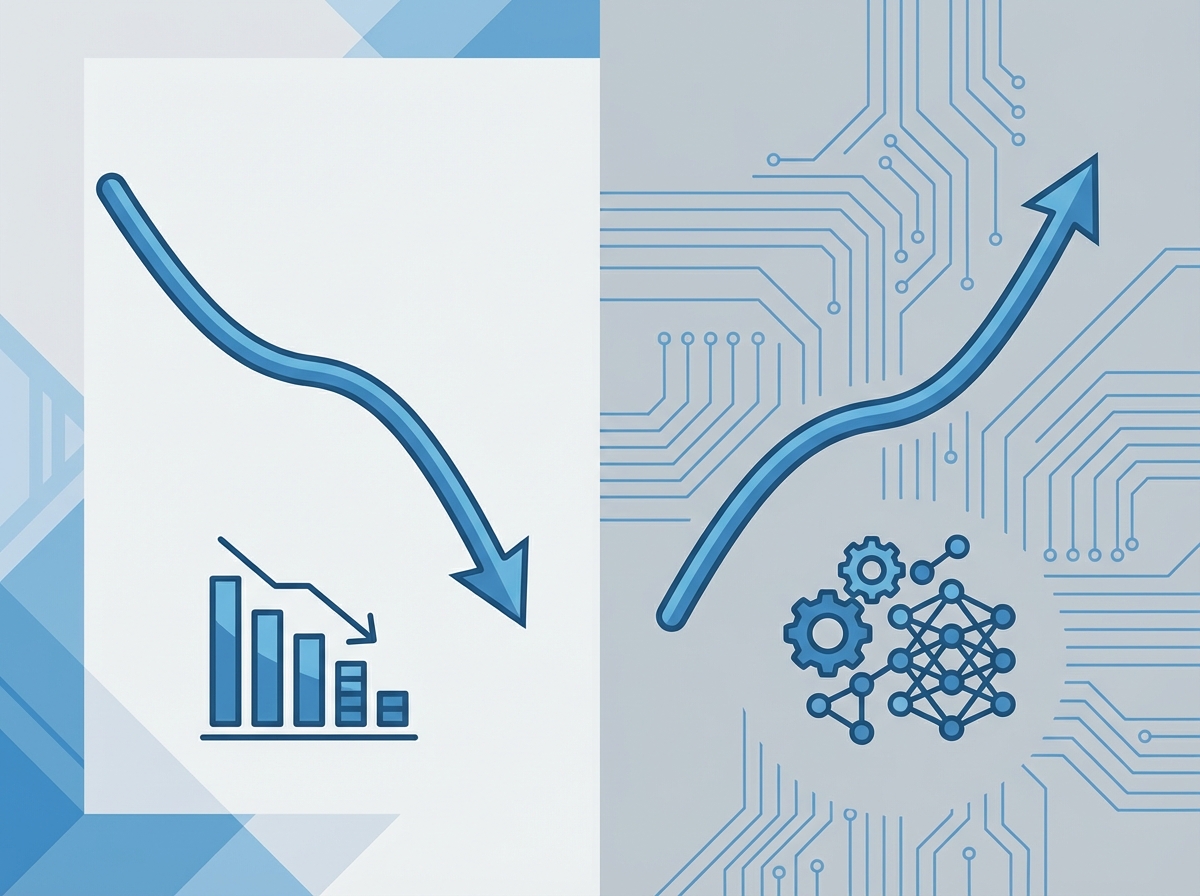
In 2025, we are witnessing a paradox in software development costs. On the surface, building software has never been faster. Generative AI tools like GitHub Copilot and Cursor have fundamentally changed the engineering workflow, reducing raw coding hours for standard tasks by approximately 30%. For founders, this creates a lower barrier to entry; the boilerplate code that used to consume a significant portion of the budget—such as authentication flows, basic UI components, and standard database connections—is now generated in seconds rather than days.
However, this efficiency gain brings a hidden counter-weight: the complexity tax. The market standard for an MVP has evolved. Users now expect intelligent, AI-driven features, which necessitates integrating Large Language Models (LLMs), setting up vector databases for Retrieval-Augmented Generation (RAG), and navigating advanced security protocols. While a junior developer can use AI to generate code faster, stitching these complex, often non-deterministic technologies into a cohesive product requires senior-level architectural oversight.
Consequently, the cost structure has shifted from paying for volume (hours of coding) to paying for expertise (architecture and security). This new dynamic forces a critical re-evaluation of how you contract development agencies:
- Fixed Price Models: These have become riskier for modern MVPs. Because AI integration involves variables like token usage costs and API latency that are hard to predict, agencies often heavily "pad" fixed quotes to protect their margins, resulting in an inflated upfront cost for you.
- Time & Material (T&M): This remains the superior approach in the current economic climate. It provides the agility to pivot when a specific AI model underperforms or a new, more efficient tool hits the market mid-development. In 2025, T&M ensures you are paying for actual problem-solving rather than an agency's risk buffer.
2. Hidden Infrastructure: The API and Cloud Tax
Gone are the days when a startup’s infrastructure budget was a flat $10 monthly fee for shared hosting. In 2025, the architectural shift from simple monoliths to serverless functions and microservices has introduced a complex, variable cost model. While these modern architectures offer incredible scalability and fault tolerance, they operate strictly on a consumption basis. You are no longer paying for a server that sits idle; you are paying for every millisecond of compute time your functions execute. This means your infrastructure bill is directly tethered to user activity, making budget forecasting far more volatile.
The most significant new line item on the modern founder's invoice is what we call "Token Economics." If your MVP leverages Generative AI—whether via OpenAI, Anthropic, or others—you are paying a literal tax on intelligence. Every user interaction involves sending input tokens and generating output tokens. A single power user on a freemium tier can cost you more in API fees than a standard subscriber generates in revenue. You must model the cost per interaction carefully; failing to cap token usage or optimize prompts can drain your runway before you even find product-market fit.
Finally, the speed of modern MVP development relies on a "Lego block" strategy, where proprietary code is replaced by third-party integrations. While this accelerates time-to-market, it creates a stack of recurring usage fees that are often overlooked:
- Managed Databases: Scalable solutions like Firebase or AWS RDS charge for read/write operations and storage. Inefficient code queries can lead to massive bills even with low user counts.
- Identity Management (e.g., Auth0, Clerk): Outsourcing login is secure and fast, but costs jump steeply once you surpass the free tier or require enterprise features like SSO.
- Communication APIs (e.g., Twilio, SendGrid): SMS verifications and transactional emails are billed per unit. A viral sign-up loop can inadvertently drain your credit card on OTP texts alone.

4. Resource Allocation: Budgeting for Iteration, Not Just Launch
One of the most dangerous financial traps for early-stage founders is "burnout budgeting"—the practice of allocating every last dollar to get the product to the starting line, leaving the bank account empty on launch day. This approach fundamentally misunderstands the MVP process. Launch is not the conclusion of development; it is the beginning of your most expensive phase: learning.
To build a resilient financial plan, you should reserve approximately 40% of your total budget for the first three months of post-launch iteration. If you have a $100,000 budget, spend $60,000 to launch and keep $40,000 liquid. Your first version will rarely be perfect. Users will uncover bugs, request unexpected features, and struggle with workflows you thought were intuitive. Without a reserved war chest, you are powerless to fix these issues, leading to high churn immediately after acquisition.
This post-launch allocation also covers the essential infrastructure required to measure success. You cannot iterate blindly; you need to budget for the tools that provide actionable data. Key costs to anticipate include:
- Advanced Analytics: Tools like Mixpanel or Amplitude are essential for tracking user behavior. While many offer free tiers, data retention and event volume costs can scale quickly once traffic picks up.
- A/B Testing Frameworks: The ability to test different value propositions or UI layouts requires both subscription costs for testing tools and additional developer hours to implement the variants.
- The Pivot Buffer: The operational cost of changing direction based on market feedback. If your initial hypothesis is wrong, you need the runway to pay your team while they re-engineer the core offering.
Ultimately, an MVP that cannot evolve is a wasted investment. By budgeting for iteration rather than just the release, you buy yourself the time and resources to turn a rough prototype into a product the market actually wants.

3. The 'Day 2' Reality: Maintenance and Technical Debt
Many founders make the mistake of treating their MVP launch as the finish line. In reality, the moment your application goes live, you enter "Day 2"—the phase where development costs shift from creation to preservation. If you haven't budgeted for what comes next, your product risks becoming obsolete or unstable within months.
A reliable industry heuristic to guide your financial planning is the 20% Rule. This standard suggests allocating approximately 20% of your initial development budget annually strictly for maintenance. For example, if your MVP cost $50,000 to build, you should earmark at least $10,000 per year just to keep the software running smoothly.
Where does this money go? It isn't spent on new features; it covers the invisible work required to keep your platform functional and secure. Key budget lines include:
- OS and Platform Updates: Apple and Google release major OS updates annually. Your app may need adjustments to remain compatible with the latest iOS or Android versions.
- Security Patching: Cyber threats evolve constantly. Regular audits and patches are non-negotiable to protect user data and maintain trust.
- Library Dependencies: Modern software relies on third-party libraries. When these external tools update or deprecate, your code must be modified to prevent breaking changes.
- Paying Down Technical Debt: To launch quickly, you likely took shortcuts or hard-coded specific features. Post-launch is the time to refactor that "rapid-prototype" code into scalable, production-grade software before it hinders future growth.
Ignoring these costs doesn't save money; it merely defers it with interest. By factoring in the Day 2 reality from the start, you ensure your MVP remains a robust foundation for the future rather than a crumbling prototype.